
Where digital boundaries are weak, burnout can follow. Image by Diliara Garifullina on Unsplash+.
As a psychologist, I help people focus on boundaries, because when boundaries are weak, burnout often follows. Burnout is a profound emotional, cognitive, and physical experience, an 'occupational phenomenon' of exhaustion, detachment, and reduced effectiveness associated with workplace stress (WHO).
As a cyberpsychologist, I know that for many of us, weak boundaries are not a personal failing. Our digital working environment makes boundaries around work extraordinarily difficult to maintain, and it’s getting worse. The Mental Health UK Burnout Report 2026 found that 91% of UK adults experienced high or extreme levels of pressure or stress in the past year. One in five workers needed time off for their mental health.
In modern working culture, chronic stress has become the norm. For anyone whose work involves screens, platforms, and digital communication, the infrastructure of work is fraught with burnout risk factors. Communication moves continuously across Slack channels, Teams threads, and email. Decisions play out in group chats and shared documents where everyone can see who responded and who didn't. Always-on, from-everywhere availability is often assumed and expected, championed and rewarded.
These shifts in workplace culture have affected people's focus, concentration, attentional flexibility, productivity, stress levels, and ability to recover from their labours. Without adequate recovery, the exhaustion, hopelessness, and depression of burnout follows.
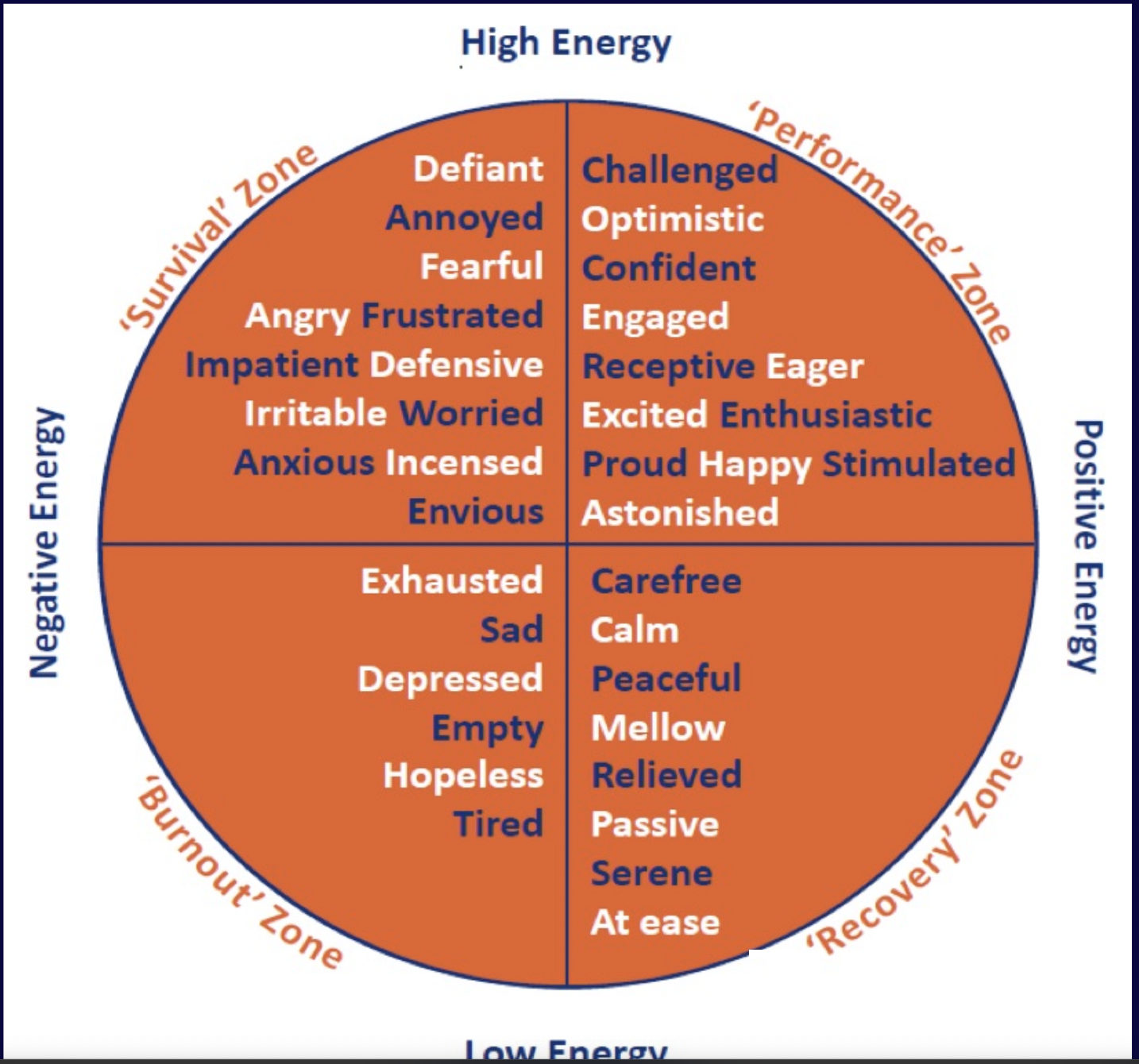
A diagram about performance, burnout and recovery, drawn from Tony Schwartz and Jim Loehr
Most organisations want their people in the 'performance zone' as much as possible. Fewer examine whether their company's digital norms support sustained performance. To improve team members' wellbeing and reduce burnout-related sickness and attrition, digital boundaries must be intentionally designed, modelled, and respected. Without them, constant availability, multi-tasking, and technology-powered productivity become defaults, affecting individual workers and the long-term resilience of the business itself.
This Cyberpsychology Basics piece gives an overview of digital boundaries in the workplace. Boundaries may be internal to the person or external, residing in the environment and working relationships. A boundary can mean an outer limit — a threshold that shouldn't be crossed — or a healthy line between contexts, roles, or states. In the digital workplace, several kinds of boundary are under pressure at once:
boundaries that protect focused attention from constant interruption;
outer-limit boundaries around cognitive capacity;
boundaries around work that protect encroachment on recovery time; and
internal boundaries that help us remain calm, grounded, and flexible in the face of workplace pressures.
This piece begins with the surveillance culture the pandemic helped embed, then examines where each of these boundary types is under pressure, and closes with what organisations can do to protect them in practice.
If you’re in a hurry, here are some key takeaways.
Key Takeaways
91% of UK adults experienced high or extreme stress in 2025. Digital boundaries help prevent burnout, and burnout prevention underpins sustainable workplace performance.
Digital boundaries take different forms: behavioural (protecting focused attention); cognitive (respecting the outer limits of mental load); temporal (protecting recovery time); and psychological (preserving the space between authentic experience and performed engagement).
The tools for working remotely and for monitoring workers both expanded rapidly during the pandemic, with insufficient consideration of the psychological conditions they might be creating.
Surveillance erodes psychological boundaries and trust. Research consistently links monitoring to increased stress, counterproductive behaviour, and higher turnover.
AI tools can reduce burnout when they replace routine tasks, but intensive AI oversight pushes people past the outer boundary limits of cognitive load, driving fatigue, decision errors, and intent to quit.
Individual resilience alone is not enough. Organisational norms are a powerful determinant of digital wellbeing in the workplace.
Book a Keynote on Technology, Wellbeing, and the Future of Work
As you're reading, keep in mind that I deliver keynotes and facilitate workshops on digital wellbeing, attention, and the psychological impact of always-on workplace culture. If you're looking for a keynote speaker on technology at work, explore my speaking offerings or get in touch.
More of my writing on digital psychology and work:
Leadership in the Digital Age: AI, Human Agency, and What Your People Need
Reset: Rethinking Your Digital World for a Happier Life — my book on navigating technology with agency and awareness
Surveillance, Trust, and the Boundaries the Pandemic Dissolved
Today's blurred-boundaries epidemic didn't happen in a vacuum. During the Covid-19 pandemic, organisations and whole professions that had never supported remote work scrambled to build the infrastructure for it overnight: new platforms for collaboration, new channels for communication, and new tools for project management.
Alongside this explosion came a parallel infrastructure of electronic surveillance — keystroke monitoring, screen capture, activity tracking, presence indicators — designed to solve a real management problem: how do you maintain quality and oversight when your team is working at a distance? The rationale was sound. But the tools for working and watching arrived together, and both were integrated fast, with less consideration for the psychological conditions they might create. The pandemic may be over, but the culture persists: remote, hybrid, always-on, from-everywhere working, with pressure to perform presence, availability, attention, and responsiveness.
The word perform is important here because performativity doesn't arise without a felt sense of an audience. The surveillance infrastructure created that audience. It doesn't matter whether anyone is reviewing the keystroke logs or the activity reports on any given day. What matters is that employees know the monitoring exists, and that knowledge alters behaviour. People begin to optimise for visibility rather than quality: sending messages to be seen sending them, staying online to register as present, responding fast to demonstrate engagement. The watchers may not always be watching, but the watched are always performing.
The research on worker surveillance is damning. When monitoring data is used for control purposes such as performance reviews and disciplinary action, employees become more likely to engage in counterproductive behaviour such as 'time theft', inattentiveness, and general disengagement. A 2024 American Psychological Association report found that over 55% of monitored employees felt anxious or burned out, compared to 40% of those who were not tracked. Companies that implemented device monitoring saw increased employee turnover. Overall, evidence suggests that surveillance undermines worker motivation and performance.
The mouse jiggler — a small device or piece of software that simulates cursor movement to prevent a computer registering as idle — is just one illustration of what can happen when organisations measure presence instead of output. Wells Fargo fired over a dozen employees in 2024 for ‘simulation of keyboard activity.’ The employees were trying to game a system that was already gaming them.
Mouse jigglers, keystroke simulators, Zoom presence spoofers: sometimes these are signs of workers who were relatively disengaged in the first place. But disengagement can also be the result of a surveillance culture that, through conflating visibility with value, provokes exactly the behaviour it hoped to prevent.
The pattern repeats across various dimensions of digital work. A legitimate need — collaboration, responsiveness, productivity, oversight — is met with a digital solution. The solution may work (at least partially) for its intended purpose. Then unintended psychological and wellbeing consequences emerge. The solution has simply created other problems.
What Happens When Digital Boundaries Are Missing
Digital environments don't cause burnout single-handedly, but they’re a significant contribution to the conditions under which burnout develops. In each of the following areas, certain technologies were adopted to serve a legitimate purpose.
Focused Attention Collapses
Without mechanisms that enable a protective boundary around mono-tasking and deep focused work, sustained attention collapses. Communication tools are supposed to keep teams connected and information flowing, but they also carry a steady stream of distracting micro-decisions. Do you respond now, or later? How should you phrase the message? What requires escalation, and what can wait? Is this more important than what I was working on? Each decision is minor on its own, but adds to a larger collective demand.
In a doomed effort to manage it all, we resort to multitasking, which carries a cost even when it seems productive. Both focus and accuracy suffer as task switching increases, and the cost is steeper when the tasks are unrelated. Moving between threads of the same project might be manageable and tax our focus less. Moving between entirely different demands, like a client deliverable juggled with a staffing question and a budget review, requires accessing a different mental model each time. The more varied the open tabs, the higher the penalty.
AI was supposed to reduce cognitive load, but for many workers it is adding to it. As multi-agent systems become more common, people find themselves managing more tools simultaneously, not fewer — and performance metrics in some organisations now reward volume of AI activity rather than quality of output. The promise of more time for meaningful work is, for many, going unrealised. Multitasking is becoming a defining feature of working with AI, not an exception to it.
The number of open tabs we're navigating has something to do with a generalised gradual drift towards generalism. Technological developments have gradually enabled people to add more and more tasks into their job descriptions, taking on new responsibilities that were once distributed across many different roles and specialisms. The boundaries between jobs have blurred as multiple functions collapse into single roles. More varied demands inevitably lead to more task-switching, which results in more cognitive cost.
With so many inputs coming at us from our digital environments, it's little wonder that the average time people spend focused on a single task has fallen from two and a half minutes in 2004 to about forty seconds in 2024. This doesn't necessarily mean our capacity for sustained attention has disappeared; it does mean that our focus needs protection from further erosion.
We Hit the Upper Boundary of Manageable Cognitive Load
The threats to focused attention described above have been building over decades, but a newer phenomenon is compounding the issue: the complex and variable cognitive demands of working with AI.
The usual AI-adoption narrative is that it will increase productivity and reduce routine work. A 2026 Harvard Business Review study bears some of this out: when AI takes over routine or repetitive tasks, workers report lower burnout scores, higher engagement and motivation, more positive emotional associations with AI, and even greater social connection with colleagues.
The same study, however, found that workers whose AI use required intensive oversight (monitoring, checking, correcting) experienced significantly more mental effort, information overload, and decision fatigue. The researchers called this 'AI brain fry': difficulty focusing, slower decision-making, headaches, and a buzzing fog that workers describe as being like a mental hangover. Productivity gains from AI peaked at around three simultaneous tools, then declined.
In these early days of AI adoption, immediate gains may be apparent first, cognitive depletion emerging only with time. Organisations that measure engagement, motivation, and emotional associations with AI in the early stages of adoption may see improvement across many metrics, conclude that AI is working, and miss the cognitive overload building in the background. By the time effects aggregate, they may have crossed the upper boundary of what their people can sustain, and beyond that boundary, burnout lies.
Diffuse Working Boundaries Prevent Recovery Time
Peak performance requires recovery. We cannot remain perpetually engaged, enthusiastic and productive without having genuine rest time, when we can be carefree, calm, and at ease. Rest is not a luxury or an interruption to productivity; it’s what makes productivity possible. Alex Pang's research on rest makes the point that serious, sustained creative and intellectual work has always depended on periods of apparent inactivity. What looks like not working is often where the work consolidates.
There are also physiological reasons why rest periods are essential. The stress hormones that help us perform (adrenaline in the short term, cortisol over longer periods) are designed to spike and subside. When they can't subside, the body stays in chronic activation. That leads not to sustained performance but first into the survival zone, then into burnout.
Intensity has always been part of professional life, but it used to be bounded by office hours, by geography, and by the fact that much of the work stayed at the desk when you left. When digital tools make intense work possible at any hour and from any location, the recovery zone becomes harder to reach and protect. Research shows that after-hours communication and expectations of constant availability increase burnout, both directly, and indirectly through the erosion of work–life balance.
For many workers, existential anxiety makes it hard for them to take time away. With such rapid AI expansion, too long an absence from the digital stream can feel like a professional risk. In your absence, you might be rendered obsolete.
When recovery time isn’t ample or boundaried enough to be restorative, sickness absence often becomes the safety valve. But crashing into burnout and taking time out is not the same as recovery. Furthermore, the Burnout Report found that among workers who took burnout-related time off and returned, over a quarter received no support at all, and fewer than one in five had a formal recovery plan. Most came back to business as usual, meaning immediate re-immersion in the same conditions. That’s not recovery; it’s the ‘doom loop’ restarting.
We Lose Ourselves When Internal Boundaries Erode
The boundaries described above are largely external: around time, attention, cognitive load, recovery. But the internal boundaries that keep us aware and respectful of our own values and limits are also under pressure.
Most of us know what we need, and we know when constant responsiveness is costing us something. We’re aware that the recovery time that we require isn't happening, that the work is expanding beyond what feels sustainable, and that the digital tools we’re using have become our masters rather than our tools. At the same time, the capacity to act on this knowledge eludes us.
Some of the barriers are real. Digital visibility, responsiveness, and demonstrated mastery of whatever tools an organisation expects its people to use have become proxies for ‘performance’ and ‘commitment’. Opting out means that we may be overlooked, passed over for promotion, or even rendered obsolete by AI. So, those fears are not irrational.
Not irrational, but also not tested. What might happen if you held a boundary around after-hours contact, response times, around which tools you use and how intensively? The anxiety prevents us from gathering actual evidence. The social pressure to conform to cultural expectations is powerful. We’re afraid of being the one who falls behind, we’re anxious about visibility. These fears operate powerfully, even when the actual consequences of boundary-setting remain hypothetical, and even as the costs to our lives and wellbeing mount.
Our routine-driven bodies make it harder. We’re operating in chronic over-activation, behaviourally habituated to our devices, and finding it genuinely hard to switch off. The habits are stamped in. The overstimulation makes reflection difficult. We used to feel like we had a choice whether to check or respond or stay available, and now it’s compulsion. Slowly but surely, the distance widens between the life we want and the life we’re living.
What Companies Can Do to Support Sustainable Workplace Performance
Workers rarely feel fully free to set healthy boundaries unless boundary-setting is culturally legitimate, explicitly permitted, and visibly supported. However well someone understands their own needs, they’re stuck in organisational power structures with both real and imagined consequences for non-conformity. To log off, respond later, decline another platform, or protect recovery time feels risky when visibility and responsiveness are treated as signals of how committed you are.
For that reason, the responsibility for digital boundaries cannot simply rest with individuals. Being resilient inside a poorly designed or overly demanding system has its limits. If organisations want sustainable performance rather than a horrible cycle of overextension followed by exhaustion, rinse and repeat boundaries must be modelled, normalised, and built into the architecture of work itself, and leaders have to practice what they preach.
Make Response and Availability Expectations Explicit
Many organisations create stress not through explicit demands, but through ambiguity. When people are unsure what is expected of them, they often default to over-functioning. They reply quickly to be safe, stay visible to avoid doubt, and remain reachable because silence can feel reputationally risky. In this way, unclear norms lead to people being chronically vigilant, just in case.
Mixed messages are common within organisations, and incredibly unhelpful. A company may publish guidance on after-hours boundaries while senior leaders routinely send emails late at night or praise instant responsiveness. The written policy says one thing, while he lived culture communicates another. Employees tend to trust behaviour over statements, but are constantly bearing the cognitive load of working out which message they should be paying attention to.
Clear expectations reduce unnecessary psychological load. What genuinely requires an immediate response? What’s truly urgent? Which channels are for urgent matters, and which aren’t? What response times are expected and considered reasonable across roles, time zones, and levels of seniority? When is someone meaningfully offline? These questions sound operational, but they are deeply psychological too: they determine whether people feel safe to relax their vigilance.
Healthy organisations deliberately make responsiveness more intentional and less performative. They distinguish ‘have to have this done soon’ from ‘nice to have this done soon.’ They don’t define visible presence as equalling commitment to the job. They don’t equate constant availability to being a valuable team member. When people know what is actually required of them, they are less likely to sacrifice their wellbeing to try and meet imagined expectations.
Protect Space for Focused Work
Focused attention has become one of the scarcest resources in modern organisations. Meetings fragment the day, or constitute the whole day. Messaging platforms keep interrupting deep thought or deep work. Notifications create a steady background drumbeat, pulling people into reactive responses. Many workers spend their time managing inputs rather than progressing meaningful work.
Yet most valuable work still depends on concentration. Good judgement, creative problem-solving, strategic thinking, careful writing, nuanced analysis, and error reduction all require stretches of uninterrupted attention. When every hour is ‘porous,’ as it were, both quality and meaning declines. Perhaps people come to rely on AI assistance play because the digital environment is so undermining their concentration that they look to AI to save the day and produce something more coherent than what they can muster themselves.
Organisations that protect focused work do it structurally. They might create protected meeting-light periods; establish and observe norms around notifications and messaging etiquette; reduce unnecessary channels; and make it legitimate and encouraged for people to be temporarily unreachable while doing cognitively demanding work. They recognise that instant access to someone is not always the highest-value use of their time.
This also means resisting the urge to convert every efficiency gain into additional demand. If AI tools or process improvements create capacity, that capacity does not need to be immediately filled with more tasks, more meetings, or faster cycles. Some of it should flow into reflection, learning, thoughtful execution, and the slower forms of work from which better decisions often emerge.
Blocking focus time in a calendar while rewarding constant responsiveness is a surface intervention, so cosmetic as to be utterly ineffectual. For attention to be genuinely protected, systems, incentives, and culture must weave together.
Set Norms Through Leadership Behaviour
Employees learn digital norms primarily through observation, not policy documents. They watch how senior people behave, what gets rewarded, and who progresses up the ladder into positions of greater power and importance. Culture is often transmitted through repeated small cues, which people absorb both explicitly and subconsciously.
An after-hours email from a leader may be intended as personal efficiency and preference, just a convenient moment to clear the inbox, although it’s unfortunate we’ve gotten to the point where 3 am is a convenient moment. It is rarely received in a neutral way. For many employees, it lands as an implicit expectation: this is what commitment looks like, this is when serious people work, this is the pace to which I should aspire. The context of a message can carry meaning beyond its content.
The same is true of meeting behaviour, response habits, and tool use. Leaders who are constantly available, permanently online, or visibly overloaded may believe they are demonstrating dedication. At the same time, they’re normalising strain, adrenaline-fuelled and cortisol-sustained working practices. When unhealthy overextension is modelled from the top, employees often infer that keeping healthy boundaries will only make you look like a slacker and limit your career.
By contrast, leaders who communicate boundaries clearly and calmly create psychological permission for others to do the same. This might mean scheduling emails to send later; clearly naming what is and is not urgent; declining unnecessary meetings; taking their full complement of annual leave, and being offline while they’re doing it; or openly protecting focused work time. When a leader does these things, they signal to team members below them that it’s safe and legitimate for them to do so as well.
Where leadership behaviour and messaging conflict, behaviour usually wins. Where they align, team members feel more psychologically safe, and trust and workplace happiness grows.
Align Wellbeing Policy with Digital Practice
Many organisations speak fluently and frequently about wellbeing. They publish their mental health commitments; run awareness campaign; offer resilience workshops; and encourage people to seek support. These initiatives may be well-intentioned and genuinely helpful. But they can only go so far if the day-to-day design of work continues to generate massive strain.
When communication is a continuous avalanche, priorities are unstable and upside down, workloads are diffuse, and responsiveness and visibility are constantly expected, employees receive two competing messages: protect your wellbeing, sure, but also remain perpetually available. People quickly notice when policy and practice pull in opposite directions, and it makes them cynical and unhappy.
A more sustainable approach asks structural rather than purely individual questions. How many communication channels are genuinely necessary? Which meetings create value, and which merely consume attention? Are workflows designed around stages of concentrated work, or around constant interruption? Is technology serving the work, or has the work reorganised itself around the technology?
Digital wellbeing is not achieved through coping strategies alone. It is shaped by workflow design, managerial habits, incentive structures, and the behavioural norms embedded in everyday systems. When organisations build boundaries into how work actually operates, healthier patterns become easier to sustain and less dependent on personal resistance.
This matters especially when someone returns from burnout-related absence. If the environment awaiting them is unchanged, a phased return may simply delay re-immersion in the same conditions that caused the collapse. Recovery requires more than time away. It often requires a different workplace to come back to.
Sustainable Performance Is a Cultural Choice
Digital platforms can support sustained, focused work, or they can introduce patterns of interruption and demand and produce ongoing low-level strain in every team member who uses them. The tools themselves are less of a mental-health problem than the conditions they’re used in, and the expectations that develop around them.
The finding that 91% of UK adults experience high or extreme levels of stress is often talked about as something the individual person needs to address. But systems are incredibly powerful. Often, systems are the problem that most needs to change. People need permission, help, and scaffolding from their environment to perform sustainably, especially when that environment has power over them, which the workplace does.
So digital boundaries are less about individual preference and practice, more about how work is structured. When protections for attention, presence, downtime, and recovery are diffuse or not there at all, stress and strain become part of everyday activity. To address this, organisations don’t need to avoid use digital tools — in the modern workplace, that would be a ridiculous notion. However, leaders do need to both model and support digitally healthy behaviours.
FAQs About Digital Boundaries in the Workplace
What are digital boundaries in the workplace?
Digital boundaries are the limits, distinctions, and protections that determine how technology mediates working life. Some are internal to the person — the boundaries that help us remain calm, grounded, and flexible under pressure. Others are external — organisational norms, policies, and cultural expectations. Boundaries can designate an outer limit (a cognitive threshold that shouldn't be crossed) or a line between contexts that need to remain distinct (work time and recovery time, urgent and non-urgent).
What is an always-on work culture?
An always-on work culture is a workplace environment where employees feel expected to be continuously available through digital channels. Response times shorten, availability is visible through presence indicators and response speed, and boundaries between work and personal time blur.
What is the link between workplace surveillance and burnout?
Electronic surveillance was more widely adopted during the pandemic to monitor remote workers. Research consistently finds that when monitoring data is used for control purposes, employees become more likely to disengage. Monitored employees report higher anxiety and burnout, and companies that implemented device monitoring saw increased turnover.
What is 'AI brain fry'?
AI brain fry describes mental fatigue from excessive use or oversight of AI tools beyond a person's cognitive capacity. AI used to replace routine tasks can reduce burnout, but AI requiring intensive human oversight increases mental fatigue. Cognitive depletion is both a component and consequence of burnout.
Why are digital boundaries important in the workplace?
Without clear digital boundaries, all types of wellbeing and balance can erode. Behavioural boundaries around focused attention collapse under constant communication. Temporal boundaries around recovery disappear when work is possible at any hour from any location. Cognitive boundaries are crossed when tool proliferation exceeds what people can manage. Internal boundaries weaken when surveillance cultures pressure people to perform engagement rather than communicate honestly. Clear digital norms support psychological safety and reduce burnout.
Is digital wellbeing an HR issue or a leadership issue?
Both. HR teams may implement policies, but digital norms are strongly influenced by leadership behaviour and organisational culture. Sustainable workplace performance requires alignment between policy, modelling, and day-to-day practice.
What is the relationship between digital boundaries and business performance?
Attention, trust, and cognitive clarity are foundations of good decision-making, innovation, and resilience. When digital expectations are unclear, all three erode. The Burnout Report describes a 'doom loop' in which burned-out workers take time off, pressure intensifies on those who remain, and more people burn out — a cycle that begins with how digital expectations are set.
References
Mental Health UK. (2026). The Burnout Report 2026. mentalhealth-uk.org/burnout
Bedard, J., Kropp, M., Hsu, M., Karaman, O. T., Hawes, J., & Rosen Kellerman, G. (2026). 'When Using AI Leads to Brain Fry.' Harvard Business Review, March 2026. hbr.org/2026/03/when-using-ai-leads-to-brain-fry
Thiel, C., McClean, S., Harvey, J., & Prince, N. (2024). 'Surveilling Employees Erodes Trust — and Puts Managers in a Bind.' Harvard Business Review, February 2024. hbr.org/2024/02/surveilling-employees-erodes-trust-and-puts-managers-in-a-bind
American Psychological Association. (2024). 2024 Work in America Survey. apa.org/pubs/reports/work-in-america
Mark, G. (2023). Attention Span: Finding Focus for a Fulfilling Life. Hanover Square Press.
Bloomberg. (2024). 'Wells Fargo Fires More Than a Dozen for Faking Work with Mouse Jigglers.' Reported June 2024.
World Health Organisation. (2019). 'Burn-out an Occupational Phenomenon: International Classification of Diseases.' who.int