
Device Mindfulness: Techniques to Increase Your Agency
Introduction to Device Mindfulness
We often fear our brains being ‘rewired’ by technology, and that’s understandable. Between 2004 and 2024, the average time people spend focused on a single task fell from two and a half minutes to about forty seconds. Does this mean our capacity for sustained attention or attentional flexibility has disappeared? Likely not. But it does mean it needs to be protected and practised. It needs to be fought for.
Our minds are naturally jumpy and distractible, forever scanning the environment for where our attention should rest. Our physical environment used to be helpfully sluggish. Not so long ago, we couldn’t get an answer to every question that occurred to us, or find a rabbit hole to fall down for every impulse, or a distraction to offset every unpleasant experience. Our informational environment was relatively slow. We were forced to make more effort, to better tolerate not-knowing, and to put up with difficult feelings.
Our devices have become so perfectly calibrated to our distractible minds that the environment no longer slows us down. It matches our human distractibility and hedonism perfectly. For some years now we’ve been in an attention economy. Now, with the rise of AI companions, we’re entering an attachment economy. Our emotional needs and cognitive processes are being relentlessly platformised — datafied, commodified, and algorithmically curated. This is being expertly done to us. And we feel helpless in the face of it.
When we feel helplessness, or indeed any other unpleasant emotion, we often default to avoidance strategies like attempted abstinence, detox, digital-free days, screen time limits, bans. But avoidance preserves fear; in fact, it’s rocket fuel for anxiety. And if we can only exercise choice when our devices are away from us, if we can only be mindful in their absence, how much freedom and flexibility, how much agency and autonomy, can we really have? If we believe our devices and the powers behind them to be completely in control, we’ll be doomed to mindlessness, because those devices are ubiquitous.
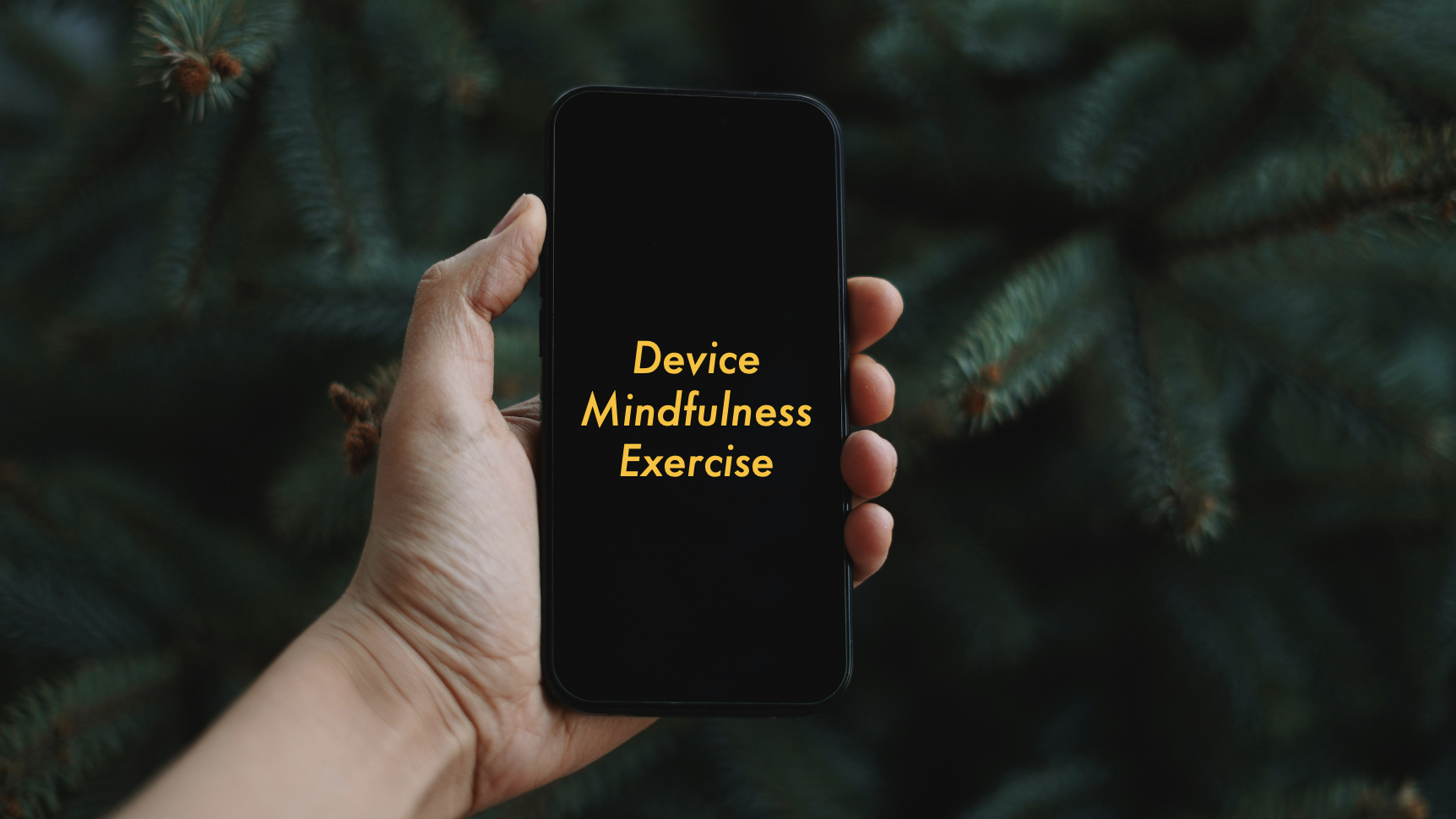
For greater agency, we need to develop the awareness and strengthen the skills to be mindful in the presence of our devices, not just in their absence. So for this device mindfulness exercise, take out your phone, or take off your smartwatch and hold the object in your hands. Don’t change anything about its usual settings. You don’t have to turn on focus mode, or silence it, or turn it off, or put it on aeroplane mode. You’ll be interacting with it as it usually presents itself for you.
The full text of the device mindfulness exercise will appear below the key takeaways, if you’d like to read it out to someone else. For our purposes, though, you’ll want to listen to the audio recording instead, where I’ll take you through the mindfulness practice. Your awareness can then be focused on your digital device, not the words on the screen!
Key Takeaways
Device mindfulness means developing awareness in the presence of your devices, not just in their absence. Avoidance strategies like detox and bans preserve fear rather than building agency.
You are in multiple relations with your phone — physical, dialogical, emotional, temporal, and identity — each of which can be noticed and examined.
The exercise moves from bare attention (noticing without judgement) to reflection (connecting past experience to the present), using time as the hinge between the two.
Four practical techniques can scaffold ongoing device mindfulness: turning the device off, placing prompts on the lock screen, device-free journalling, and asking someone what they notice about you and your phone.
The people around you have their own complex relations with their devices, and they have been watching yours. Device mindfulness is both individual and relational.
Speaking
As you’re engaging with the mindfulness exercise, keep in mind that I deliver keynotes and facilitate workshops on digital wellbeing, attention, and the psychology of our relationships with technology. If you're looking for a speaker on these topics, check out my Digital Wellbeing keynote and other speaking offerings.
You might also be interested in my related pieces.
Phubbing: Your Phone is the Third Wheel in Your Relationship
Reset: Rethinking Your Digital World for a Happier Life — my book on navigating technology with agency and awareness
The Device Mindfulness Exercise
Look at this object, which is perhaps your constant companion, with fresh eyes. This object may have become so integrated into your movements through your internal and external worlds that you barely notice it anymore.
Now, intentionally, shift from your usual relation to a position of deliberate awareness, even of wonder, or awe. The essence of mindfulness is awareness, in the present moment, without judgement. For the next few moments, I invite you to summon your curiosity, and your noticing, but to suspend evaluation.
You are in physical relation with this object. Be curious toward the item in your hands. Feel the materiality of it. Sense the places where its materials meet your skin: the metal, the glass, the fabric or material of any case. Perhaps materials you don’t know exactly what they are. Which parts of you are in contact with it, and what sensations are there? Smoothness, roughness, coolness, warmth? Edges, surfaces? If it’s hard to tell where it ends and you begin, notice that. Feel its contours as though you have found it in the wild and do not know what it is. How many of your senses can you bring to be aware of this object? Notice that there is only so much of it that you can see, that you can appreciate. It has this weight, it has an inside that is invisible to you, and with your eyes you cannot see what these insides are, or what they’re doing.
You are in a call-and-response, dialogical, interactive relation with this object. As you hold it, notice if it calls out to you. It may illuminate. It may vibrate or make a sound. It may present you with words or an image. It displays its colours. You may feel as though you are being urged to respond, to do something. Observe that sensation without following through. Notice what it is like not to follow through; perhaps to suppress a reflex, an instinct. What sensations in your body do you notice in response to that reflex, that instinct? Where are those sensations? How do they feel? How strong are they?
You are in an emotional relation with this object. It is a mobile emotive device. What emotions do you notice flickering in you as you hold the object now? Fear? Anxiety? Guilt? Pleasure? Interest? Temptation? Relief? Do not follow these emotions into a narrative or a memory. Simply notice them. Name them if you can, if they have a name. Observe where the emotions register in your body.
You are in a temporal, time-related relation with this object. Notice what is happening to time right now, as you sit with it. Feel how even in this moment of stillness, the object may exert some kind of pull, towards the future, or towards the past. Time may feel like something has changed about it since this exercise began. Observe any pull or any change in your sense of time without doing anything, without following any impulse.
We are now going to move from bare attention on the present to something more like reflection.
Consider your temporal relation once more, but differently. You may have sat down with this object for a moment and surfaced to find that an hour had passed. Perhaps you were lost in a scroll, or a feed, or a loop. Or perhaps you were absorbed in something — creating, learning, connecting — and the time was not lost, but rather well spent. Hold this object now and consider that you are cradling something that contains so much of your past while pulling you constantly toward the next moment. What emerges for you as you consider this?
Return to the emotional. You noticed, a moment ago, those feelings flickering in the moment. Now let your mind follow the feelings into your history with this object. Sometimes it may have offered you an escape hatch from difficult emotions, hard conversations, other people, tedious moments, less stimulating environments. You may have taken that escape hatch. When did you last choose the object, knowingly or unintentionally, over someone or something physically present? When did you last turn to it for answers because you mistrusted or second-guessed yourself? When did you choose its simpler pleasures over something more complex? When did it last make you feel hollow and detached: from yourself, from the world, from another person? And when did it last bring you joy, or connection, or fulfilment, or all of those things? When did it help you, rescue you, even save you?
Return to the dialogical, the interactive. A moment ago, you observed that call-and-response: the interaction, the pull to act, the reflexes I invited you to observe without responding. Now reflect on the history with this relationship. When has a vibration, illumination, call, or notification interrupted a thought, a conversation, a moment of rest, and you responded before you had decided to respond? When has it brought you something you needed or craved: a loved one’s voice, a welcome or useful piece of news, something interesting, a connection arriving at exactly the right moment?
Return to the physical. You felt where this object meets your skin. Now consider: when did you last reach for it without thinking, without awareness? When did it appear in your hand as though it had placed itself there? On the desk, in your pocket, in the car, on your person, in your home, at your workplace, at leisure, this object has its accustomed places. How close to your body is it right now? Is this its usual level of closeness? Is it different? Is this contested, is this difficult for you, figuring out this closeness that may be a comfort, a compulsion, or both?
You are in an identity relation with this object. It is a mirror, kind of, but it reflects back a version of you that is both you and not you. It has learned your habits, your preferences and patterns. It may predict what you want before you want it. It serves you back to yourself: through algorithms, recommendations, the curated archive of your photos, messages, searches, your whole history. What is it like to hold this thing that purports to know you, that calibrates to you, in ways that both do and do not work for you?
Technology functions in myriad ways for you. You, individually, in particular ways. In some ways it may deepen your experience, your consciousness. In others it may fracture, fragment, and render you unintentional and unaware. Because this object is a tool like no other, we forget that it IS a tool. We put it to use. Like a hammer, it can be used to build, and it can be used to damage. What have you built with it? What have you damaged with it?
Imagine the complexity of this ongoing relation, in all of its layers: the many things this single object is for you, and the many things it does to you and for you.
What might be different if you were able to regularly, even habitually, mobilise this level of awareness about this object, and your relations with it? What could change? How would you change?
Now, gently, bring your attention back to the room. Observe the object in your hands once more, with as many senses as you can: its weight, its surfaces, its appearance, its other qualities, perhaps even its smell.
When you are ready, set it down.
Post-Mindfulness Reflection
Whatever you just noticed, many others feel this too. We are subject to the same forces. The people around you have their own complex relations with their digital objects. And they have been watching your behaviours, consciously or subconsciously, just as you have been aware of theirs. They may have feelings about your relation with your digital objects, as you may have feelings about theirs, because our social worlds are miniature attention economies, and there are winners and losers in these economies. Often, it is the devices and forces behind them that win.
We need all the scaffolding we can get to strengthen our awareness, to shift ourselves into a more mindful position. So here are four practices that may scaffold your device mindfulness beyond this exercise.
Techniques to Prompt Device Mindfulness
Technique One
Turn it off.
Turn it not ‘to sleep’, not onto focus mode, not onto silent, not onto aeroplane mode, but actually OFF. Notice if you feel any resistance even as you read these words.
If you do feel resistance, that’s understandable, because we have an embedded culture of ‘always on’. I found some research from the Pew Research Center from 2015, over a decade ago now, that indicated mobile phone owners either rarely (45%) or never (31%) turned them off. I couldn’t find anything more recent. I’m fascinated by the fact that, since that time, researchers don’t seem to have even considered it worth mounting a research project to ask the question.
Anecdotally, you know the answer. On a plane, you’re asked to put the device into aeroplane mode. In the cinema, it’s suggested you put it on silent. For sleep, experts recommend you put the device in another room but rarely mention turning the thing off. And we do these things under duress or because we’re asked to, rarely just because, for our own sake.
Try this, more often, just because. Turn it off and hold it. Notice how it becomes inert, somehow more purely material than it was before. Notice what arises in you, for it might be a lot of things: discomfort, relief, quiet, anxiety, the urge to power it back up. How long will you decide to sit with a dark screen? What does it feel like to hold a tool that is, for now, just an object?
Try experimenting with this, turning off the object several times a day. Notice the thoughts as well. What are the worries that present themselves? What might you miss? What might people assume or even accuse you of? What might happen to optimised battery life? What broken connections with headphones or smartwatches might present a headache when you power back on? Notice the influence and power of these thoughts in your relation with the object.
Technique Two
Put words on its face.
Choose a phrase. It could be a question that prompts greater conscious awareness of what you’re thinking or feeling. It could be a reminder of a value, a valued activity. It could be a prompt such as, what would you do if you didn’t have this phone right now?
These words, if you commit to taking them in and engaging with them when you see them, can really interrupt your automatic, mindless usage of or response to the object. The phrase meets you at the threshold of opportunity, inserts itself between the reaching and the scrolling. It’s useful friction, just before all the familiar processes kick in at an unconscious, strongly learned level.
You will need to change the words regularly. A phrase you've seen five hundred times will inevitably become invisible to you; it will lose its power. The friction wears smooth and won’t work any longer, won’t catch your attention in the same way. Notice how often you need to change the phrase for this technique to be effective in maintaining your mindfulness.
Technique Three
Sit without it, with something to write with.
Take yourself somewhere. It could be a café, a park bench, your sofa, or your kitchen table. Be without your phone. Bring unconnected technology with you: paper and a pen, a notebook, whatever you have to hand, remembering that these too are technologies. The point is to have something analogue: something that receives your thoughts without feeding anything back.
Sit with these prompts.
Begin with your senses. What can you see? What can you hear? What can you smell? What can you taste? What can you feel on your skin? (This is a classic noticing mindfulness exercise.) Take a moment with each one. This is where you are and what is around right now, without the device. Write these noticings down.
Move to your inner world. Notice what bubbles up in your thoughts. What is your mind giving you? As you watch them, write these thoughts down, without censoring them, as though you were the mere recorder or observer of these thoughts. Each time you notice a moment where you wish you had your phone, or are frustrated that you can’t follow an impulse using your phone, make a mark there.
Notice too what feelings are present. What emotions present themselves, positive and negative? Here too you may be aware of your phone’s absence.
As you observe what feelings are there, every time you feel the phantom-limb itch of your phone’s absence, make a little mark.
All of the above may involve physical sensations as well. Where those occur, write these down as well.
Finally, shift from mindfulness to reflection. What inner and outer experiences, sensations, observations, and interactions did you experience, in your device-free journalling session, that would have been curtailed, suppressed, avoided, or otherwise circumvented had your phone been present? What had the chance to peek above the parapet, what made its way into your awareness, that would have otherwise stayed dark, silent, or repressed?
In a journalling session like this you may become far more aware of how your devices function for you, and the complexity of your relations with them. Try this regularly. Over time, your observations become a record, not of your phone usage, but of the texture of your experience with and without it. This strengthens your awareness and your ability to be deliberate when your devices are present.
Technique Four
Ask someone.
This technique takes courage and willingness. Ask a person who matters to you — a partner, a friend, a family member, a colleague — a simple, open question.
What do you notice about me and my phone?
Be prepared to sit openly and with curiosity in the face of whatever comes back. Try not to defend, explain, or justify, but instead just listen. This may be difficult!
You are asking for someone to serve as a human mirror, someone who has been watching your relation with this object from the outside, probably for a long time, and who may have feelings about it that they have never been invited to express. This is a different kind of data from anything your screen time tracker can offer you.
What they tell you may surprise you, or it may confirm what you already suspected. Either way, you have opened a conversation that is too infrequently had: not about screen time, but about how your device functions in the space between you and the people you are with.
Remember that this is mutual. The other likely has their own complex relation with their own devices. You have been aware of theirs too, either at or below the level of explicit consciousness. We affect one another, unintentionally sending one another messages about our importance or significance relative to the devices. The point is: this open question, asked with genuine curiosity and without judgment, can become a shared, relationship-nurturing practice.