
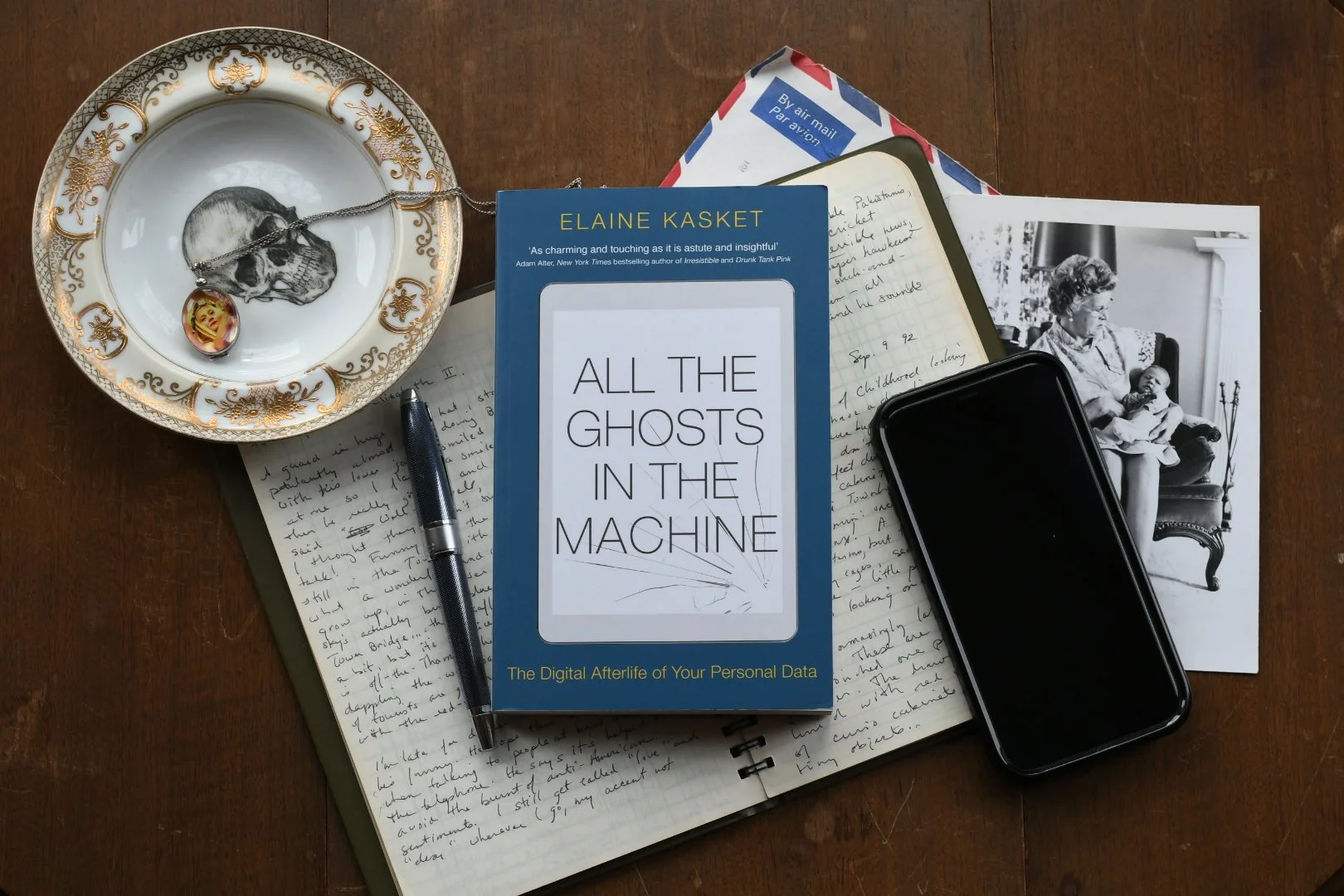
All the Ghosts in the Machine: The Digital Afterlife of Your Personal Data
Originally published in trade paperback and audiobook as All the Ghosts in the Machine: Illusions of Immortality in the Digital Age (2019). The paperback carries the subtitle The Digital Afterlife of Your Personal Data.
'Moving first-hand interviews and unnervingly honest recollections... a finely crafted comedy of intellectual errors' — New Scientist
How and Why Everyone Needs to Prepare for Their Digital Afterlife Cyberpsychologist Elaine Kasket explains digital afterlives in this Dying Matters Awareness Week talk, covering what happens to your data, social media accounts, and digital legacy after death. Includes nine practical tips for getting your digital life in order, from making a digital-era will to curating your online legacy. Based on her book All the Ghosts in the Machine: The Digital Afterlife of Your Personal Data.
Rebel Book Club, June 2020 Cyberpsychologist Elaine Kasket introduces All the Ghosts in the Machine, Rebel Book Club's June 2020 pick. A short overview of the book's key themes: digital remains, digital legacy, online memorialisation, and what happens to your data when you die.
Still Spoken Vodcast A mini-documentary on digital afterlives, grief technology, and the ethics of living on online after death. Cyberpsychologist Elaine Kasket is joined by leading experts including Carl Öhman (Oxford Internet Institute), Albert Gidari (Stanford), Morna O'Connor (Nottingham), Carla Sofka (Siena College), and Patrick Stokes (Deakin University) to explore the history of living with the dead, online memorialisation, holographic resurrections, and the beauty and challenges of digital remains. Based on themes from All the Ghosts in the Machine.
The book
I wrote All the Ghosts in the Machine because of a dead stranger on Facebook. In 2005, I stumbled across her profile. Her friends had created another page to mourn her on this then-new, fast-growing social media site. That began my journey: over two decades now of studying death in the digital age. As the years passed, the questions I started asking in that first encounter kept getting bigger, more complicated, and more interesting.
Those questions, and their answers, have never been more urgent than now. The combination of digital remains and AI has spiked interest in All the Ghosts in the Machine. The book uses the lens of mortality to cast a brighter light on our power relationship with big tech, the privacy dilemmas that the living share with the dead, and the consequences for us all when the digital dead are owned by corporations and stay in their social networks, message threads, and email chains.
This is not a niche book about death. We are entering a particularly exploitative and extractive era for the digital dead: their data scraped for AI training, their likenesses reanimated without consent, their dormant accounts a security risk and governance blind spot for every organisation that holds them. The dead are being turned into training data, posthumous influencers, and products you can subscribe to. All the Ghosts in the Machine was one of the first books to map this terrain for the general public. If you work with data, AI, product development, or customer trust, this book will be particularly crucial for you now.
The dead don't delete their accounts, and generally speaking, we don’t delete them either. So their profiles and accounts persist, usually owned and controlled by the platforms they joined when alive. Their faces, voices, and work outputs keep surfacing for or are sought by their friends, family members, and erstwhile work colleagues. Social media platforms have become vast and growing digital cemeteries, and the bereaved are navigating a kind of grief that has no precedent: mourning someone whose digital presence keeps showing up, indeed never disappears.
This book maps that territory. Drawing on my background as a cyberpsychologist and counselling psychologist, and on years of interviews, clinical work, and research, I explore what happens at the intersection of death, data, and human psychology. Who owns your digital remains? Who decides what happens to them? What does it mean to grieve someone whose online self is still, in some sense, here?
What the book covers
The book traces the lifecycle of digital remains and the questions they raise for the living.
Death and data
When someone dies, their digital footprint doesn't die with them. It persists across platforms, in cloud storage, in the caches of other people's devices. The early chapters examine what 'digital remains' are, why they matter, and how unprepared most individuals, families, platforms, and legal systems are for dealing with them.
Grief in the age of social media
Online memorialisation has transformed mourning. You can now grieve publicly, in real time, in front of an audience of hundreds. The book explores what this means for the bereaved — the comfort of collective grief, but also the boundary violations, the trolling of the dead, and the collision between private loss and public platforms.
Privacy, consent, and identity after death
Your data tells a story about you, but it's a story you can no longer control. These chapters examine who gets access to a dead person's accounts, the legal and ethical tangles around digital inheritance, and what happens when the living and the dead have competing interests in the same data.
The digital afterlife industry
From companies selling posthumous messaging services to startups promising digital immortality, a market has grown up around the desire to preserve the dead in digital form. I examine the promises, the business models, and what it all says about our relationship with mortality.
AI and the reanimation of the dead
The final chapters look at what happens when artificial intelligence meets digital remains — and this is where the book has become far more relevant than I could have predicted when I wrote it. Grief bots, posthumous avatars, AI-generated voices of the dead: the technologies I flagged as emerging possibilities in 2019 are now front-page news. The questions I raised about consent, exploitation, and the ethics of digital reanimation are now urgent policy debates. My later book Reset extends this conversation in its own 'Digital Afterlife' chapter, and I continue to explore these issues as a Visiting Professor at the Centre for Death and Society at the University of Bath, and as a contributor to the International Declaration on Protecting Digital Remains.
Why this book matters now more than ever
I published All the Ghosts in the Machine in 2019. Since then, generative AI has exploded. Large language models can now produce convincing simulations of a dead person's voice and conversational style from relatively modest data. Companies like Meta are patenting technologies for platform-scale posthumous AI. The data of the dead is being scraped, mined, and monetised with even less restraint than the data of the living — because the dead are out of contract, and the legal protections are minimal.
The questions at the heart of this book — who controls your data after death, whether your digital remains should ever be used to simulate you, and what all of this means for how we grieve — are no longer hypothetical. They are here, and most people are still unprepared.
I speak in the UK and internationally on digital afterlives, grief technology, AI and death, and the ethics of digital remains. Explore my speaking offering.
REVIEWS
What readers and reviewers say
'This sense of balance in writing is rare and hard to achieve but was flawless. Kasket writes from her perspective, using a witty and engaging style... It is impossible to read the book and not be concerned about what your digital legacy might be. The book does not politely ask permission to consider these issues; it demands the reader's attention.' — Simon Bignell, The Psychologist
'Kasket's novel insight is to suggest this may mark a sea change in how we experience death, and in the place and influence of our ancestors in society.' — Samuel Earle, Times Literary Supplement
'As charming and touching as it is astute and insightful. Kasket observes that, until recently, fame was the only way to guarantee that your identity would outlast your lifespan; today, however, billions of lives are preserved as digital remnants after death.' — Adam Alter, New York Times bestselling author of Irresistible
'I read this book with the sinking realisation that my favourite response to a problem — "worry about it later" — is not really an option... Dr Kasket, who writes with a pleasingly self-deprecating wit and a determination to give every side of an argument a fair hearing, is as comfortable exploring the philosophical implications of digital legacies as she is on the legal and scientific nitty-gritty.' — Jake Kerridge, Sunday Telegraph
'A thorough and much-needed interrogation of an issue which, quite literally, faces us all. Through heart-rending family stories and expert testimony, All the Ghosts in the Machine reveals how the Wild West of the social media industry is grappling with (and in some cases actively exploiting) human mortality.' — Geoff White, author of The Lazarus Heist and Crime.com