
Phubbing: Your Phone is the Third Wheel in Your Relationship
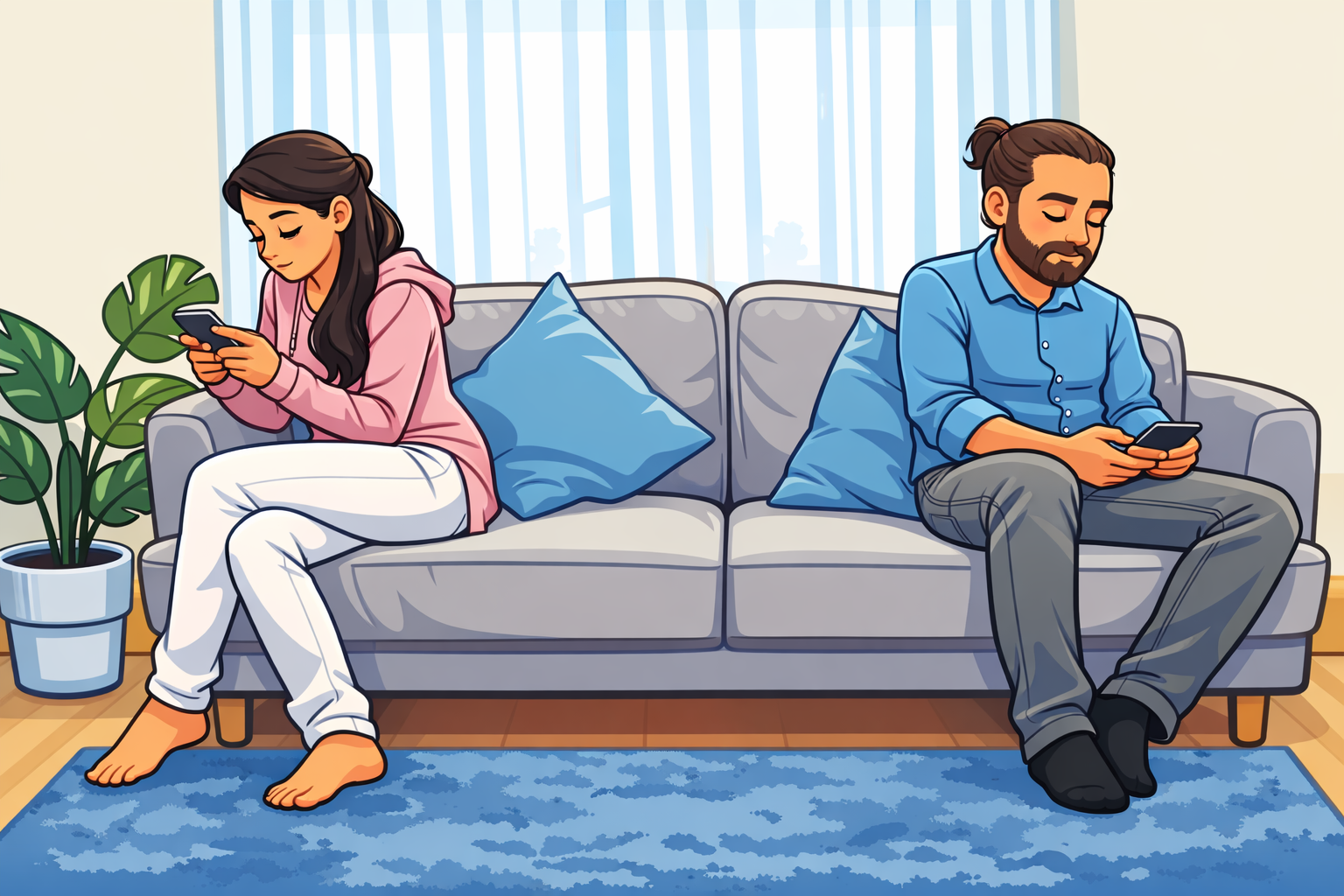
AI-cartoonised version of an image from Unsplash+, where phubbing features in nearly every picture that appears with the keyword ‘ignoring'.
Phones are like third wheels in our relationships, constantly competing for our affections. They play starring roles in tales of tension and uncertainty, intimacy sought or thwarted, connection or betrayal, boundaries respected or crossed. They are our allies, our enemies, our private investigators. Sometimes they’re that one frenemy who stirs up trouble by telling you something because if they were you, they’d want to know.
Remembering all the couples I’ve seen for therapy over the last two decades, I’d say that for many of them, phones had a lot to answer for. Not because of what was on the phones, necessarily, but because of what phones were doing to the quality of these couples’ attention, their trust, and their sense of being important to each other.
The behaviour at the centre of much of this damage has a name: phubbing. Short for phone snubbing, phubbing refers to the act of ignoring someone you’re with in favour of looking at your device. It has become so normalised that most of us barely notice when we do it or when it’s done to us. But the fact that it’s ordinary doesn’t mean it’s harmless. Phubbing influences how we experience closeness and intimacy, and becoming more aware of and intentional about our phone usage is one of the most important things we can do for our relationships.
I’ll attempt to untangle a lot here, including individual psychology, relationship dynamics, and what we can do about phubbing. But if you're short on time, here are a few high-level points.
Key Takeaways
Phubbing means phone snubbing, which is ignoring someone you’re with in favour of a mobile device. The term was coined in 2012, the same year smartphone sales surged by 45 per cent worldwide.
Research shows that phones are experienced as potential portals to virtual others, which is why partner phubbing stings differently from someone reading a newspaper or a book.
Phubbing directly undermines perceptions of a partner’s commitment, responsiveness, and appreciation, all of which have been shown to be central in healthy relationships.
The avoidance or distraction that phubbing provides may be a way of managing anxiety and discomfort. Sometimes, we express our attachment patterns through our device use.
You cannot have healthy intimacy without clear boundaries. Learning how to deal with phubbing begins with having the conversations that many couples avoid.
Even the visual presence of a phone in the room has been shown to reduce feelings of closeness and perceived empathy between conversation partners.
As you’re reading, keep in mind that I speak in the UK and internationally on topics like phubbing, digital wellbeing, attention, and the psychological impact of constant connectivity on relationships at work and at home. If you’re looking for a keynote speaker, workshop facilitator, or panellist on these topics, explore topics on my speaking page.
More of my writing on digital psychology and relationships:
The Gold Digger in Your Phone: Why AI Relationships are Corporate Romance Scams
Reset: Rethinking Your Digital World for a Happier Life
Most of the material in this blog post is adapted and expanded from my latest book, Reset.
What Is Phubbing?
In 2012, a team of Australian linguists noticed a subtle new behaviour spreading through everyday life, and they combined ‘phone’ and ‘snubbing’ to coin the word phubbing.
That same year, worldwide sales of smartphones exploded by 45 per cent. People were trading in their older handsets for web-connected devices, and the social contract around attention was rewritten. Using your phone in company was once considered rude, a violation of social norms. But by 2015, 90 per cent of people had used their smartphones in their most recent social interaction.
In psychological terms, phubbing is more than a lapse in etiquette. It signals a shift in attention away from the people who are physically present, and towards everyone who isn’t. For those on the receiving end of phubbing, this can feel like emotional withdrawal, even when no harm is intended. Over time, chronic divided attention can erode trust, closeness, and the sense of being valued in a relationship.
What Does Phubbing Look Like in Everyday Life?
Phubbing occurs in moments so ordinary and frequent we hardly clock them anymore. Staring at your phone while a friend’s speaking, scrolling during dinner, or texting in bed are familiar phubbing behaviours that are frequent and automatic that they barely feel like a choice.
In my consulting room, I see some generational differences. At the start of sessions, most of my older clients put their phones away. But some younger clients always keep their phones firmly in hand, or right beside them on the arm of the chair. Sometimes they clutch them while telling me about their struggles with Instagram, or their inability to maintain attention on anything or anyone at all. I have no reason to think those phones are any further away from them when they leave the session and rejoin their partners, friends, colleagues, or families.
Evidence suggests that we’re far more likely to phub the ones we love, a phenomenon some researchers call “pphubbing”, with an extra ‘p’ for partner. Phubbing in relationships has been found to increase feelings of exclusion, decrease perceived partner responsiveness, and lessen feelings of intimacy.
Why Has Phubbing Become So Normalised?
Phubbing has become normalised because constant digital engagement is now woven into every corner of life. Phones are used for work, connection, coordination, entertainment. Frequent checking feels practical rather than disruptive. In many settings, divided attention has simply stopped being noticed or questioned.
Perhaps partly because of their omnipresence, the way we now experience our phones as almost extensions of our bodies, we struggle to maintain awareness of how often we engage with them. It becomes harder to recognise that conversations about phone use in a relationship are even necessary. And anyone who’s been in a relationship knows that discussions about love, attention, and what makes us feel valued are not easy to begin. When emotional stakes are high, when the territory provokes anxiety about rejection, it’s difficult. Situations of love and commitment always have the spectre and fear of loss on the opposite side of the coin.
When discussions are hard to broach, or when you always go down the same conversational patterns with your partner, perhaps ending up in conflict, simply not mentioning the phone thing can feel like the easier option.
The Psychology of Phubbing
Emotion, Not Simply Distraction
Phubbing is often written off as distraction, and there’s no question that our attention and focus is being expertly manipulated by devices we use. Phones are designed to interrupt and compel us. Notifications, updates, and messages arrive unpredictably, which encourages frequent checking, but that’s especially true especially during moments of boredom, stress, or uncertainty. When checking a device offers brief relief from discomfort, it becomes a default response surprisingly quickly, even when it undermines presence with the person sitting right in front of you.
Attention responds to interruption, excitement, and novelty, and a device can readily become a tool for managing feelings we’re becoming less and less tolerant of, including boredom or unease. Many people reach for their phones to find momentary reassurance, a sense of connection, or a way to sidestep awkwardness in the moment. In social settings, the phone functions as a buffer, something to reach for when attention feels demanding or exposure feels uncomfortable. In relationships, this creates distance without intention. One partner may be using their phone to self-regulate, but their other half may feel that it’s about withdrawal or disinterest. The behaviour may not be deliberate, but the emotional impact is real.
Why Attention to Phones Has a Different Impact
One study found that staring at a phone was far more damaging to a relationship than staring at a newspaper. The phones in that study had something the static reading material didn’t: they were two-way rather than one-way objects, dialogical rather than monological. They were portals for communication with a virtual other.
Think about what that means in practice. When your partner picks up a book, they’re consuming static words. When they pick up their phone, they could be communicating with anyone, doing anything. The phone introduces the spectre of a rival, real or imagined. Following their gaze, you look at their phone and wonder what, or who, is so much more compelling than you.
For people who already struggle with self-esteem, watching a partner’s attention shift to an electronic rival is often experienced as a threat and a driver of romantic jealousy. A message to another person doesn’t have to actually happen for someone to feel diminished and unworthy of their phubber’s full attention.
But it doesn’t have to be another person to sting. Your partner could be infinite-scrolling social media, or doomscrolling the news, or catching up on work emails. The content might be meaningful or it might be completely hollow and idle. It doesn’t matter. The message received is the same: they’re busy, and you’re not as important as whatever is on that screen.
This is what makes phubbing so psychologically loaded. The phone carries the weight of every possible thing your partner might prefer to be doing: every person they might prefer to be talking to, every piece of content they find more compelling than you, every demand on their attention that trumps your presence.
Understanding this dynamic moves the conversation from blame towards something more useful: rather than asking why someone can’t put their phone down, it may be more productive to consider what role the phone is playing in that moment.
When the Virtual Other Is an AI
The virtual other on the other side of that screen isn’t always a person. Increasingly, it’s an AI.
I recently encountered an example that, tragically, may be increasingly common. A couple were going through a difficult time in their relationship, and often navigating that difficult time via text. The man had been feeding his partner’s messages into ChatGPT, then copying and pasting the AI’s suggested responses back into the messaging app. He was outsourcing his engagement with her to a chatbot. When his chat logs with the AI were discovered, his partner felt profoundly betrayed. She’d been negotiating he romantic relationship with an AI for nearly half a year.
This is a new frontier for phubbing, and for ‘technoference’ more broadly - technoference meaning the intrusion of technology into our everyday interactions. When we use AI to craft the ‘perfect’ response to a partner, or to strategise our way through difficult conversations, we’re not just being inattentive. We’re introducing a third party into the most intimate exchanges of the relationship. We become disconnected, disaffected, and, whether we intend it or not, manipulative. The presence we offer isn’t ours. And when that’s discovered, the betrayal can feel just as acute as if a human rival had been involved. Sometimes more so, because the person realises they were never really talking to their partner at all.
How Phubbing Damages Relationships
What the Research Shows
Think about a current or past relationship. How has your partner’s technology use coloured your perceptions of their commitment to you, or their interest in spending time with you? Did it make you feel more or less cherished and important? Now consider whether your own technology use made you more or less aware, appreciative, and attentive towards your partner, and how they might have perceived your interest in them relative to whatever was happening on your device.
I ask those questions because the research on what actually sustains relationships is striking, and it speaks directly to why phubbing matters so much.
A large machine-learning study published in 2020 gathered over forty existing psychological studies examining couples’ relationship quality over time and subjected them to hundreds of hours of computational analysis. Interesting, individual characteristics — personality, shared interests, matching backgrounds, the things people list on dating apps — might matter in getting people together, but once a relationship is established, a ‘good match’ on those dimensions is relatively unimportant.
What predicts relationship contentment over the long haul is something more immediate and more fragile: people’s judgements and perceptions. How satisfied and committed they perceived their partners to be, and how appreciative they themselves felt towards their partners, explained 45 per cent of relationship satisfaction. Conflict and sexual satisfaction also appeared in the top five important factors.
Now consider what phubbing does to those perceptions. When one person repeatedly turns to their phone during shared moments, it directly chips away at the sense of being valued, appreciated, and prioritised — the very perceptions that hold relationships together. Research on partner phubbing has found that it increases feelings of exclusion, decreases perceived partner responsiveness, and lessens feelings of intimacy. People who feel marginalised by a partner’s phone use may eventually give up and turn to their own devices, creating a downward spiral of reciprocal disconnection. Or the person being phubbed might become convinced that their partner is dissatisfied, that their commitment is wavering — and they might decide to act on what they’re imagining to be true.
The Power of the Phone’s Presence
Even the mere visual presence of a phone changes the emotional texture of an interaction. A phone lying dark and unused on a piece of furniture has been shown to have a measurable negative impact on feelings of closeness and how much empathy we perceive our conversation partner to have. In an investigation conducted in coffee shops, people watching strangers in conversation rated the dialogues where those strangers had phones in their hands as being less fulfilling.
The device doesn’t need to ring or vibrate. It doesn’t even need to be switched on. It simply needs to be there, a reminder that attention could be pulled away at any time, that presence is conditional, that your conversation partner is always on the cusp of a better offer.
Eyes, Gaze, and Why Presence Is Primal
But whatever is happening or not happening on our screens, the eyes are still the windows to the soul. From our earliest days, eye contact matters for feelings of closeness and affiliation with others. When we’re babies, reciprocal gazing with our carers makes us feel safe and loved and promotes trust. Researchers studying pre-verbal infants measure interest and attachment by recording what and who the babies are looking at, and for how long. For the rest of our lives, when we see someone we care about, we want to be seen back. A partner gazing at you makes you feel attractive and liked. The aversion of that gaze is associated with disinterest and disengagement.
Never have our loved ones been up against so much competition for the visual attention that our brains naturally interpret in terms of love, care, self-worth, inclusion, and importance. Our environment is rife with electronic rectangles that pull, capture, and keep our gaze. And the person sitting across the table from you, trying to tell you something that matters to them, cannot compete with a device that has been engineered to hold your eyes.
Phubbing in the Bedroom
Phone-snubbing has entered the bedroom as well. Most smartphone owners charge their devices next to them while they sleep, despite many good physical, psychological, and relational reasons not to. Many of us have phubbed or been phubbed in bed, and many describe how they’ve missed out on physical intimacy as a consequence. Sex sometimes gets short shrift when technology has reconstructed the bed as a place for work, communication with the outside world, and more technologically mediated entertainments.
How to Deal With Phubbing
Start With Awareness, Not Blame
Phubbing rarely happens on purpose. Most people genuinely don’t notice how quickly their attention shifts to a phone during conversations or shared time. The first step in learning how to stop phubbing is recognising when it happens and noticing what’s going on internally in that moment — boredom, anxiety, avoidance, habit. These are the moments that our devices are designed to exploit, and we need to give ourselves and others some compassion for that. The goal isn’t to judge or correct. It’s to become more aware of how attention is being used, and why.
In my experience as a therapist, the distinction between ‘you’re being rude’ and ‘what’s going on when you reach for your phone?’ makes all the difference in whether a couple can talk about this productively. Phubbing is almost never about rudeness. Treating it as a relational pattern rather than a personal failing opens up the conversation rather than shutting it down.
Remember That Boundaries and Intimacy Go Together
Relationships need boundaries that define and respect where one person stops and the other begins; that safeguard individual autonomy, space, and privacy; and that protect the relationship from intrusions that could erode the bond over time. Agreeing on phone-free times — during meals, important conversations, in the bedroom — might sound like a small thing, and yet it isn’t. These boundaries signal availability and respect. They work best when they’re shared rather than imposed, and when they’re understood as being about connection, not control.
Notice What Triggers the Urge to Check
People often reach for their phones during moments of boredom, awkwardness, or emotional strain. Noticing those triggers makes it easier to pause before reacting. In many cases, the urge is less about the phone itself and more about seeking reassurance, distraction, or relief from discomfort. And, of course, always remember that your attention is being powerfully manipulated by your devices, making them formidable opponents.
Have the Conversation Most Couples Avoid
Many couples have never explicitly discussed boundaries and feelings around devices. Raising phubbing in the moment, without accusation, prevents frustration from building in silence. Simple requests — ‘I’d love to walk without phones today, just us’ — let your partner know what you value and are missing, rather than provoking defensiveness. Approaching it as a shared issue rather than one person’s fault definitely helps as well.
Rebuild Connection Through Presence
Repair doesn’t require grand gestures. Slowing conversations, making eye contact, practicing listening without interruption, putting your phone more often in another room: these small shifts in attention can quickly restore the sense of being heard, seen, and valued. Over time, they rebuild the trust and emotional closeness that phubbing quietly erodes.
What you’re doing, when you put the phone down and look at the person in front of you, is restoring something primal. You’re telling them, through the oldest and simplest language we have: you matter, I see you, you have my full attention now.
Choosing Presence Over Your Phone
Reducing phubbing doesn’t mean rejecting technology. It means noticing how attention is used and making deliberate choices about when to be fully present. It means recognising that clear boundaries and healthy intimacy go hand in hand, and that the conversations we find hardest to have are often the ones our relationships need most.
Further Reading
The research cited in this article — including the machine-learning study on relationship satisfaction, the studies on partner phubbing and technoference, and the phone-vs-newspaper research — discussed in depth, with full references, in my book, Reset: Rethinking Your Digital World for a Happier Life. (The hardback has the title Reboot: Reclaiming Your Life in a Tech-Obsessed World.)
Frequently Asked Questions About Phubbing
What does phubbing mean?
Phubbing means phone snubbing — ignoring someone you’re with in favour of looking at a mobile device. The word was coined in 2012, the same year that worldwide smartphone sales surged by 45 per cent. What had been considered rude was fast becoming unremarkable.
What some phubbing examples?
The most familiar phubbing examples include checking notifications while someone is talking to you, scrolling during meals, texting while pretending to listen, and reaching for your phone during quiet or emotionally charged moments. The defining feature is that they happen so routinely that they barely register as choices, which is part of why they’re so damaging.
Why does phubbing hurt relationships?
Phubbing in relationships is damaging because research shows that the strongest predictors of long-term relationship satisfaction are perceived commitment, responsiveness, and appreciation. Phubbing directly undermines all three. Phones also carry a dimension that passive distractions don’t: as two-way communication devices, they introduce the possibility of a virtual other, which can trigger jealousy and insecurity even when nothing is actually going on.
Is phubbing a sign of phone addiction?
Phubbing psychology is more nuanced than ‘addiction’. People tend to reach for their phones during moments of boredom, stress, or emotional discomfort as a way of regulating feelings, not always because of a compulsive need for the device. The concept of ‘phone addiction’ is complicated, especially since ‘addiction’ situates the problem within the individual, when we’re all in a situation where our attention is being expertly manipulated.
How can I stop phubbing?
Learning how to stop phubbing starts with noticing when you do it and what’s happening emotionally in that moment. From there, it helps to set shared, phone-free boundaries, including during meals, in conversations, in the bedroom. But the deeper work involves recognising the emotional triggers and attachment patterns that drive the behaviour, and being willing to have the conversations that most couples avoid. The couples who can name the pattern together, without blame, are far better placed to change it.
What is pphubbing?
Pphubbing — with an extra ‘p’ for partner — refers specifically to phubbing within romantic relationships. Research on pphubbing has found that it increases feelings of exclusion, decreases perceived partner responsiveness, and undermines intimacy. We’re more likely to phub the people closest to us, which makes pphubbing one of the most common sources of relational friction in the digital age.
What is technoference?
Technoference describes the way technology functions as both a distraction within a relationship and the means through which relational anxieties are expressed and acted out. When a phone becomes a tool for reassurance-seeking, avoidance, or surveillance, it stops merely interrupting the relationship and starts reshaping it.